

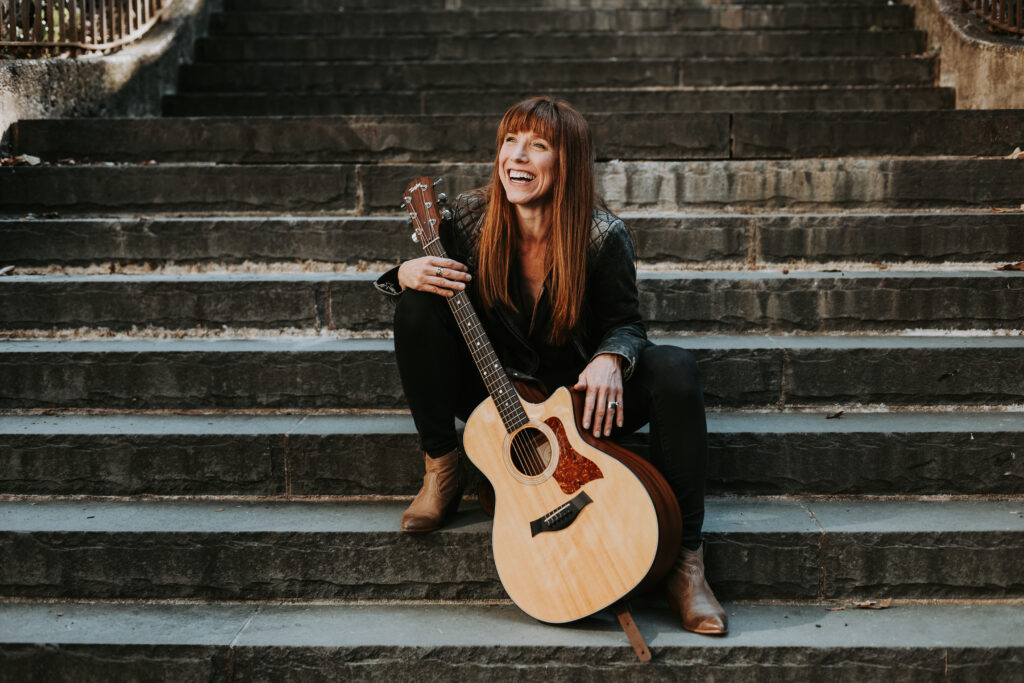
Songwriter, professor, and author Kat Reinhert joined Music Will for a live masterclass on songwriting. Below, we've pulled her most actionable insights to help you and your students finish more songs and beat creative blocks. You can watch the full replay at the bottom of this post.
As a songwriter, vocalist, multi-instrumentalist, bandleader, producer, author, and educator, Kat Reinhert is an artist who defies categorization. She has released five independently produced albums, 8 singles, and an EP, holds a doctorate in Music Education, specializing in Popular Music Education, and is the co-founder of Songwriting for Music Educators. She has authored and co-authored several books on songwriting, contemporary voice, and popular music, including Songwriting for Music Educators and How to Release Music: A Guide for Educators, Mentors, and Authors, and has written for Sesame Street. When she sat down with Music Will for a live masterclass, she brought all of that into a conversation that was practical, honest, and immediately useful for teachers and students alike. Here are her seven key strategies:
Pick Up an Instrument You Don't Really Play
One of Kat's most counterintuitive tips: when you feel stuck in your writing, switch to an instrument you don’t normally play. Why it works: An unfamiliar instrument forces you to listen differently and stumble into ideas you wouldn’t find otherwise. For teachers, this is a powerful classroom strategy to get your students to build new habits. She discovered this herself when she picked up a guitar during the pandemic, despite having owned one for years and having played the piano since she was eight. "I actually found it ridiculously freeing because I didn't know what I was doing.”Serve the Song, Not Every Detail
Songwriters often get hung up on biographical accuracy. Kat says you need to push back on the idea that the song's story must be 100% literally true. "You have to serve the song, not necessarily the legitimate truth of the story," she explained. For example, if the real event happened on the Manhattan Bridge but the word Brooklyn better evokes the feeling you’re chasing, you use Brooklyn. If your drink was a cappuccino, but the song needs two syllables, it becomes a latte. "Be true to the ethos of the story and the feelings, but some of the details can shift and change to make sure you're serving the song." This mindset may be liberating for students who feel locked into autobiographical accuracy. The feeling is the anchor, and the details are in service of it.Build Your Lyric Vocabulary by Reading Everything
Kat describes herself as a "huge lyric nerd," and her advice for getting better at lyrics starts not with writing, but with reading. "Read everything: read magazines, read books, read fiction books, read science books, read books that are interesting to you, read poems. Because you need vocabulary and you need stuff in your head. That's where you get it. Your brain starts finding words." Building a mental library of language is foundational work that pays off over time in ways that feel almost unconscious.The Biggest Tip: Finish the Song
If you take one thing from this masterclass, it's this: finish your songs. "I think it's really important to finish songs. And so there are those out there that are like, I never finished songs because I don't think they're gonna be good. I'm like, you don't know if they're gonna be good or bad. They're just not done, period." Kat runs a song-a-day challenge every January, which involves writing a full first draft in one hour (including a warm-up). These aren't polished gems. They're finished drafts. And that distinction matters enormously. The goal is simply to complete the work, knowing you can go back and rework the ones you like later. Getting into the habit of finishing is the core, non-negotiable skill.Is Writer’s Block Real? (A Controversial Take)
For some, Kat may have a strong opinion on writer’s block: she doesn't believe it exists. "I do think we have struggles to write, but the struggle is not the writing. The struggle is actually the fear that it's going to be good. That is what stops people from writing." Her reframe is simple and memorable: what you write has to be done. You can make it good later. And if you do feel genuinely stuck? She has a science-backed prescription: go for a walk. Disengaging your brain from the task allows neural synapses to work, often leading to a cool new idea halfway through the walk. She quoted author Sarah Lewis: "Mastery is the absence of unnecessary thinking," and called it one of her favorite ideas in creative life. Rather than chasing "perfect," which is unattainable and subjective, pursue mastery: the state where you've done the work so many times that the friction disappears.Be a Constant Observer of the World
Kat keeps a running list of "song seeds" in her phone, currently sitting at around 500 ideas. When she read a few aloud, the list jumped from "the communal stress of humans and how it's contagious" to "cotton candy unicorn glitter." Everything counts. "As a songwriter, you are an observer of the world. And so I'm just writing down random thoughts that come to my head.” The practical upside: she never sits with a blank page. When she's ready to write, there's always a seed to start from. For teachers, encouraging students to keep their own ongoing list, even a messy and unfiltered one, can dissolve the paralysis of starting from nothing.Follow the Songwriters, Not the Artists
Kat’s final piece of advice for students who want to take songwriting seriously: stop following artists and start following the people who write their songs. When you Google a song's lyrics, the writers will be listed at the bottom of the page. Following the careers of these people (the songwriters) reframes the entire learning process. The people making the fundamental decisions about melody, lyric, and structure are often invisible to casual listeners. Making them visible to students opens up an entirely different way of studying music.Want to Go Deeper?
Kat has co-authored the essential resource for music educators working with songwriting in the classroom: Songwriting for Music Educators (with Sarah Goulish). Even if you're not an educator yourself, it walks through the songwriting world from multiple angles and is a practical companion to everything covered in this session.Watch the Full Masterclass
Everything above is just the highlights. Kat goes deeper on melody shapes, co-writing, how to troubleshoot a song that isn't landing, beginner exercises for students just starting out, and more. And if you're ready to put these ideas into practice with your students, the Music Will Songwriting Exhibition is the perfect place to do it. Sign up for the Songwriting Exhibition → https://musicwill.org/songwriting-exhibition/The Latest from Educator Spotlights


Load More