

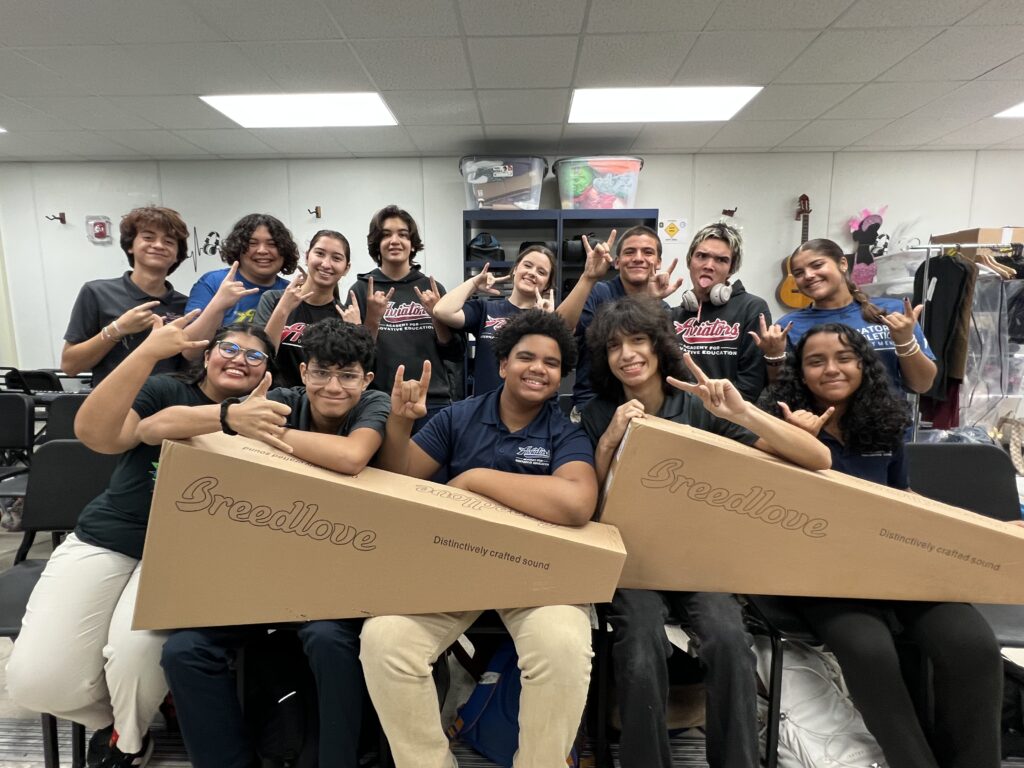
Breedlove Guitars has donated 250 handcrafted instruments to Music Will, expanding access to high-quality guitars in public school classrooms nationwide. This partnership helps ensure students have the instruments they need to learn, create, and stay engaged as they build their musical skills.
With new Breedlove guitars now in classrooms, the focus shifts from access to impact by supporting teachers as students move beyond the excitement of starting guitar and into sustained growth as musicians.
Why This Matters in the Classroom
With new guitars in hand, students often hit a predictable learning plateau. The strategies below help teachers keep students engaged, challenged, and making music long after the first chords.
Keeping the Momentum: Getting Over the Beginning Guitar Slump
You made it through the first stage of new guitarists in your modern band. Students are scaffolding and approximating, playing simple songs with easy three-string chords, even splitting the changes so you can do 4-chord songs with student-selected repertoire.
But uh-oh, interest starts to drop. For some students, the material has gotten too hard. For others, it feels too slow. What comes next?
This isn’t unusual. Most guitarists hit a slump around here. They can play open chords but can’t switch them fast enough to play along, they lack dexterity to play faster melodies, or they rely heavily on watching their hands and can’t read the chart.
The good news? With the right classroom strategies, students can push beyond the basics while still having fun.
Focus on the Fretboard
Build fretboard awareness while reducing reliance on visual cues.
Ask students to drop their fret hand to their side. Call out a finger, fret, and string, count to three, and have everyone play together:
“Finger 2, fret 2, string 3!”
This exercise reinforces finger and string names, builds muscle memory for the feel of the neck, and strengthens left and right-hand coordination. As students improve, shorten the count. When they’re ready, have them try it with their eyes closed. This helps students begin memorizing the fretboard and rely less on visual cues.
Phrasing for Building Strength
Develop speed and accuracy without making practice feel mechanical.
Faster, more accurate finger movement comes from repetition but it doesn’t have to feel mechanical. Introduce slides, hammer-ons, and pull-offs early using real songs. These techniques build strength while keeping students engaged.
Learning short riffs that feature these movements helps students develop important skills that support everything else they play. Slides, in particular, help students improve accuracy as they move around the fretboard. A quick search will turn up many accessible riffs and examples that work well in class.
Exploring Open Chords
Use anchor fingers and movement to reduce frustration.
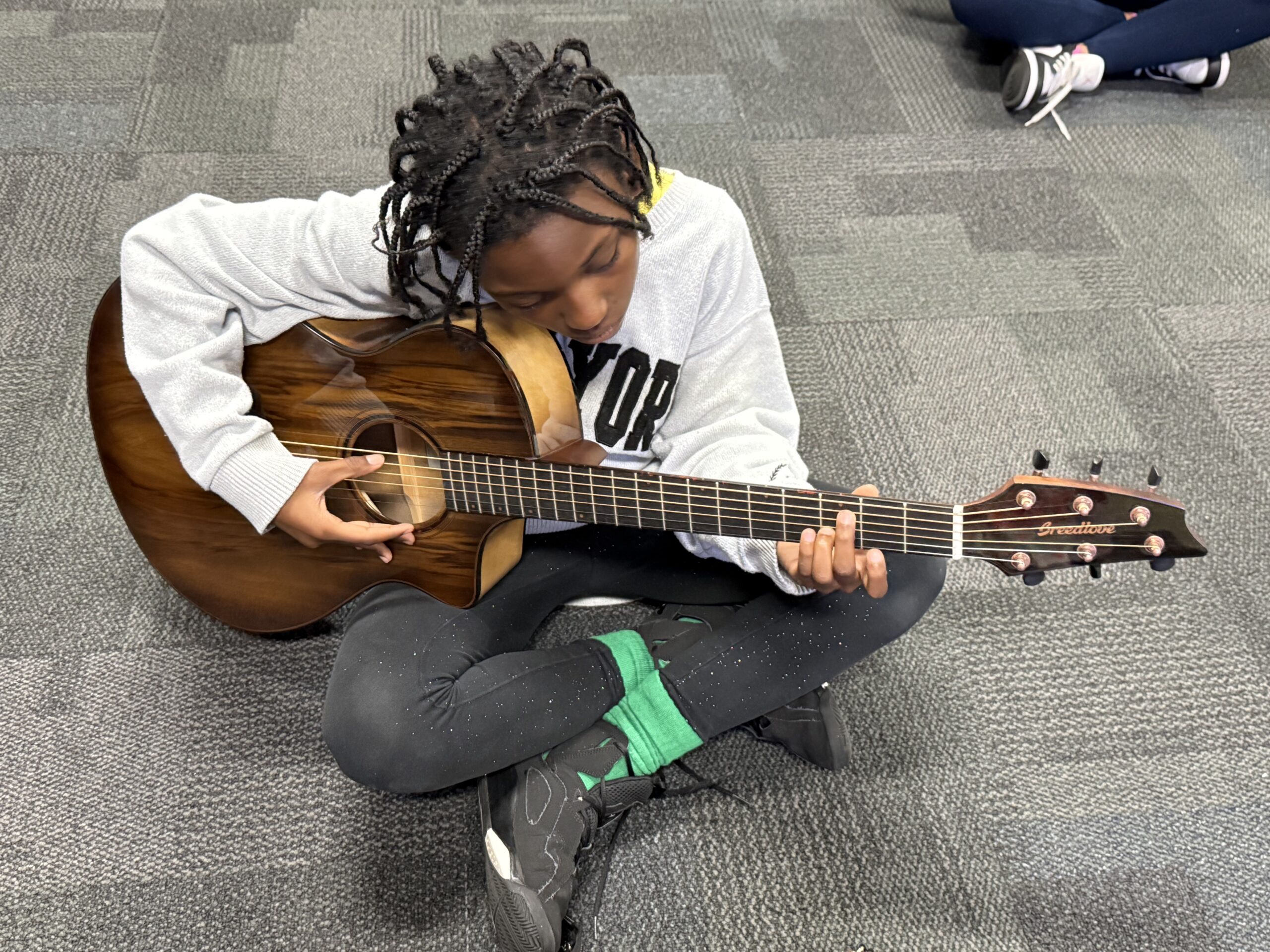
Switching open chords is one of the most frustrating stages of learning guitar, and it’s often where beginners give up. One way through is to start with chord pairs that move easily and focus on anchor fingers.
For example, switching between Am and C keeps fingers 1 and 2 in place while finger 3 moves. Start slowly and increase the tempo as confidence builds.
Open chords can also be explored compositionally. Take an E chord, play it for a measure, then slide the entire shape up one fret to create a new sound. Encourage students to experiment with different positions and notice how the sound changes. This approach also works well with Am, D, and C shapes.
“But it’s too easy!”
Challenge advanced students without separating them from the class.
Some students will move faster than the rest of the class. Instead of pulling them away, give them ways to push themselves while staying aligned with the group.
If the class is using an easy C, have advanced students play open C. If the class is on open C, they can use a barre C. During rhythm or scale practice, they can play double-time or use more advanced syncopated strumming patterns. When working on songs, invite them to improvise over the chord progression once they have it down. This challenges advanced players and shows others what’s possible with practice.
More Resources – and Why This Partnership Matters
With Breedlove’s donation of 250 guitars, more classrooms now have the tools to put these approaches into action. Breedlove’s commitment to craftsmanship and access ensures students are learning on instruments designed for quality sound, playability, and long-term use.
Paired with Music Will’s modern band curriculum and national educator network, this partnership supports not only student growth but the long-term sustainability of music programs across the country.
↗ Explore Music Will resources on Jamzone
↗ Learn more about Breedlove Guitars